

If you’ve recently purchased an electric vehicle (EV) or are eagerly awaiting delivery, you’ve probably quickly realized the limitations of plugging into a standard wall outlet. “Level 1” charging via a standard 120-volt outlet adds just 3 to 5 miles of range per hour. For most drivers, that’s simply not enough to replenish a battery overnight. When it comes to home EV charger installation, Wasatch Front drivers are rapidly upgrading to a dedicated Level 2 home charging station to change the game. Running on a 240-volt circuit—similar to an electric clothes dryer—a Level 2 charger can add 20 to 45 miles of range per hour, ensuring you wake up to a fully charged battery every morning.
When planning a home EV charger installation, Wasatch Front homeowners must first choose hardware that fits their current vehicle and future-proofs their garage. With the auto industry currently standardizing around the NACS (North American Charging Standard), picking a charger that fits your current car and future-proofs your garage is more important than ever.
Here is a breakdown of the top hardware options on the market today.
Top Home EV Chargers for 2026
Tesla Universal Wall Connector
The Tesla Universal Wall Connector is widely considered the most versatile charger on the market today.
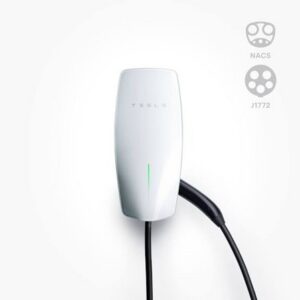
What makes it “universal” is its built-in integration of both the NACS plug and a J1772 adapter. When you pull the handle out normally, you get the NACS plug (perfect for Teslas and newly manufactured 2025/2026 EVs). If you press the button on top of the handle while pulling, it releases the built-in J1772 adapter to charge older EVs.
- Power: Up to 48 Amps (11.5 kW)
- Best For: Multi-EV households where one car is a Tesla and the other is a different brand, or for future-proofing your home as the industry transitions fully to NACS.
Ford Charge Station Pro
If you drive a Ford F-150 Lightning, the Ford Charge Station Pro is a powerhouse designed specifically to handle massive battery packs.
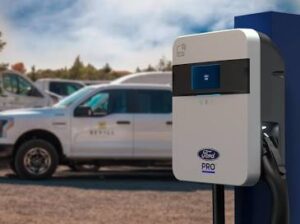
This unit can output a massive 80 Amps, cutting down the charge time significantly for larger trucks. It is also required if you want to utilize Ford’s Intelligent Backup Power, which allows your F-150 Lightning to act as a backup generator and power your home during a grid outage.
- Power: Up to 80 Amps (19.2 kW)
- Best For: Ford F-150 Lightning owners looking to utilize bi-directional charging for home backup power. (Note: While 2025+ Fords are transitioning to NACS natively, this station heavily supports the J1772/CCS1 ecosystem for current Lightning models).
Rivian Wall Charger
Designed to match the rugged, clean aesthetic of the R1T and R1S, the Rivian Wall Charger is a fantastic option for Rivian owners.
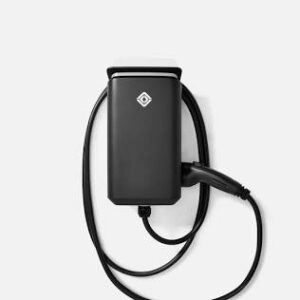
It integrates seamlessly with the Rivian app, allowing you to monitor charging speeds, set schedules to take advantage of off-peak energy rates, and view energy consumption over time.
- Power: Up to 48 Amps (11.5 kW)
- Best For: Rivian purists who want all their vehicle and charging data housed neatly inside a single smartphone app.
ChargePoint Home Flex
If you want a premium third-party charger that isn’t tied to a specific automaker, the ChargePoint Home Flex is consistently rated as a top choice.
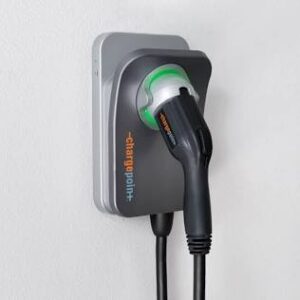
The Home Flex can be installed as a hardwired unit or plugged into a NEMA 14-50 outlet (though hardwiring is required to reach its maximum 50-amp speed). ChargePoint also offers this unit with either a J1772 or a NACS cable, depending on what your current vehicle requires.
- Power: Up to 50 Amps (12 kW)
- Best For: Drivers looking for an excellent, feature-rich smartphone app and the flexibility of choosing a plug-in installation for easier future removal.
Preparing For Your Home EV Charger Installation
Installing a Level 2 charger isn’t a DIY weekend project. It requires interacting with your home’s main electrical panel and adhering to strict National Electrical Code (NEC) guidelines.
Here is what your electrician will be looking for during a home assessment:
- The 125% Rule: EV chargers are considered “continuous loads.” Under NEC rules, the circuit breaker must be rated for 125% of the charger’s maximum output. For example, if you want your charger to deliver 48 amps of power, your electrician must install a dedicated 60-amp breaker.
- Panel Capacity (Load Calculation): Your electrician will perform a load calculation to ensure your home electrical panel has the total capacity to handle the new charger alongside your AC unit, electric stove, and dryer.
- Physical Space: A Level 2 charger requires a double-pole breaker (which takes up two slots). If your panel is physically full, your electrician may need to add a subpanel or combine existing circuits.
- Hardwired vs. Plug-in: While installing a NEMA 14-50 outlet allows you to easily unplug and take the charger with you if you move, hardwiring the unit directly to the electrical panel is generally safer, looks cleaner, and is legally required to achieve charging speeds over 40 amps.
Why You Need a Licensed Electrician
Because an EV charger pulls a massive amount of sustained current for hours at a time, any loose connections can generate extreme heat, posing a severe fire risk. For any home EV charger installation in the Wasatch Front, a licensed electrician will ensure all connections are torqued to manufacturer specifications, pull the necessary municipal permits, and ensure your home’s total electrical load remains safe and up to code. If you are ready to upgrade your garage, reach out to the Best of SLC award-winning team at JP Electrical to schedule your home EV charger installation in the Wasatch Front today.