

Your Home’s Secret Bodyguard: Why Whole-Home Surge Protection is Non-Negotiable

We’ve all been there: a heavy electrical storm rolls in, the lights flicker, and you scramble to unplug your laptop or high-end TV. But in the debate of power surge vs. power spike, many homeowners don’t realize that the danger isn’t just the big lightning strike—it’s the silent, daily wear and tear on your wires.
At JP Electrical, we’ve seen how one “hiccup” from the grid can turn thousands of dollars of technology into expensive paperweights. If you’ve been wondering, “Can a power surge ruin a refrigerator?” or a smart home automation system, the answer is a resounding yes.
Here is why your main electrical panel needs a dedicated bodyguard and why electrical storm protection is no longer optional.

The $15,000 Vulnerability
The average modern home contains upwards of $15,000 worth of sensitive electronics. It’s not just the obvious stuff like phones and gaming consoles. Today’s LED light bulbs, smart thermostats, and even your EV charging stations contain delicate circuit boards.
While a $20 power strip might protect a bedside lamp, it does nothing for the “big ticket” items hardwired into your home. A whole-home Surge Protective Device (SPD) acts as a gateway, stopping transient voltage before it ever enters your internal wiring. This is the only way to truly focus on protecting smart home devices from lightning and grid instability.
It’s More Than Just a Good Idea—It’s the Law
If you are building a new home or performing residential electrical panel upgrades, you might not have a choice in the matter. The National Electrical Code recently updated the NEC 2023 surge protection requirements to mandate protection for all new and replaced service equipment in one- and two-family dwellings.
Why the change? The “grid” is getting more complex, and our appliances are getting more sensitive. The code-makers realized that protecting the home’s “brain” is now a fundamental safety issue and a key way to prevent electrical fires caused by over-voltage.

Type 1 vs. Type 2: Choosing Your Shield
When we perform an SPD installation at the panel, we usually look at two specific types of “bodyguards”:
- Type 1 SPDs: Installed on the “line side” (between the utility pole and your main breaker). These are your first line of defense against massive external surges, like a transformer blowing up.
- Type 2 SPDs: Installed on the “load side” (inside your main breaker panel). These protect your home from both external surges and—more importantly—the smaller, frequent surges generated inside your house when your AC or vacuum kicks on.
Pro Tip: Roughly 80% of surges are generated inside your home. Every time a large motor turns on and off, it sends a tiny spike through your wires. Over time, these mini-surges “degrade” the circuits in your electronics until they eventually fail.
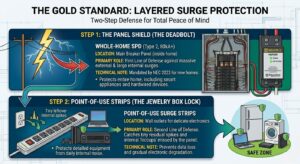
Why “Layering” is the Gold Standard
Does a whole-home SPD mean you can throw away your power strips? Not quite. We recommend a “layered” approach for the best whole house surge protection in 2026:
- The Panel Shield: A Type 1 or Type 2 SPD to catch the big hits.
- Point-of-Use Strips: For your ultra-sensitive gear (like a home office or theater system) to catch any tiny leftovers.
Think of the whole-home SPD as the deadbolt on your front door, and the power strip as the lock on your jewelry box. You need both for total peace of mind.
Protect Your Investment (and Your Warranty)
Installing a Whole-Home SPD is one of the most cost-effective insurance policies you can buy. Beyond the hardware, there are two major financial perks:
- Appliance Warranty Requirements: Many manufacturers now require surge protection to be in place to honor a warranty claim on a fried circuit board.
- Home Insurance Discounts: Some providers offer home insurance discounts for surge protection because it significantly lowers the risk of fire and electronic damage claims.
Get a Professional Quote Today
If you’re curious about the whole house surge protector installation cost, or if you need a licensed electrician for surge protection in [Your City/Area], we are here to help.
Don’t wait for the next storm to find out you’re unprotected. [Link: Contact JP Electrical today] for a safety inspection and shield your home from the unexpected.
Categories: Uncategorized
Leave a Reply